
Crossing the electronic divide
Can an acoustic drum brand really become an electronic drum company? History suggests it’s a far tougher transition than most manufacturers expect.

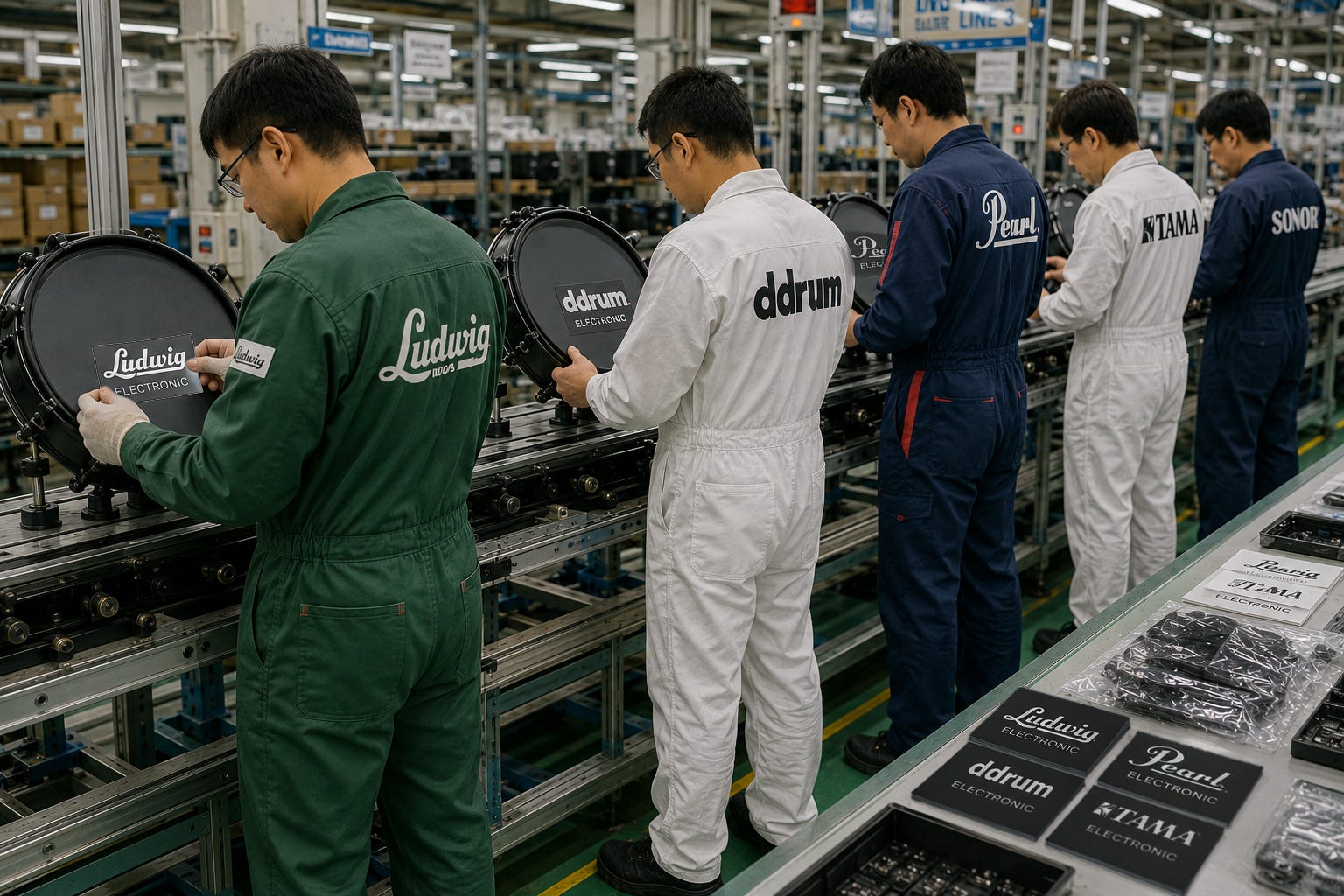
AI image created with ChatGPT
Electronic percussion is the fastest-growing segment of the drum market. For companies built on acoustic instruments, the pull is obvious. Growth in traditional lines has slowed, while electronic kits continue to bring in new players. In practice, recording and live use cases have also expanded the category’s reach.
The difficulty is that building an electronic drum system is not an extension of acoustic design. Shell construction, hardware engineering and finishing do not naturally translate into low-latency triggering, software architecture or sound design. The gap has been underestimated repeatedly, sometimes with expensive consequences.
The OEM shortcut
For many brands, the simplest route in is partnership with an original equipment manufacturer (OEM). Rather than building trigger systems and software from scratch, they adapt existing platforms and move to market more quickly. As in other product categories, it is a common approach across the music industry. The question is how much of the final product meaningfully belongs to the brand on the badge.
Most drummers are unfamiliar with names such as Medeli, Ringway, Aroma or Jinbao, yet their role in the e-drum ecosystem is substantial. Medeli products appear under brands including Alesis, ddrum and a range of retail labels. Ringway manufactures for a number of Western brands, including EFNOTE and Simmons, while other factories supply hardware that reappears under multiple identities. In some cases, the same underlying platform is distributed across several brands with only minor variation.
Ludwig’s recent entry into electronic percussion illustrates the point. Its debut multipad shares a hardware platform with products such as the Avatar PD708, ddrum NIO, dbdrums nPad, Millennium Nona Pad and Gear4Music DD90. Ludwig has applied its own branding and sound set, but the underlying architecture is already familiar in the market. That does not define its quality so much as it frames the question: what, exactly, is being added at brand level?
Pearl’s path has been more layered. The SY1 Syncussion appeared in 1979, predating the Simmons SDS-V often cited as the starting point for modern electronic drums. The DRX-1 followed, placing Pearl briefly at the early edge of the category.
Its return to electronics decades later has been more uneven. The ePRO Live module era leaned heavily on OEM architecture paired with pads that struggled to gain traction. More recent products have been stronger. The mimicPRO was built around Steven Slate Drums technology, while the e/Merge combines Pearl’s hardware with Korg engineering. These are collaborative systems, which is increasingly the norm rather than the exception. In most categories that would not be controversial. In drums, it tends to raise quieter questions about authorship.
The go-it-alone disasters
Building an electronic percussion ecosystem from scratch is rarely quick, never inexpensive, and often unforgiving of missteps. The list of brands that have attempted it is long enough to suggest a pattern rather than a series of isolated cases.
ddrum is a useful example. Once an early pioneer in electronic drums, the brand still carries residual recognition among long-time users. Since its acquisition by Armadillo Enterprises, its direction has shifted several times. One early hybrid effort paired ddrum’s external triggering system with a mid-tier acoustic shell pack. The logic was straightforward, though the end result sat awkwardly between categories.
More recently, attention turned back to its electronic heritage. A 2024 digitalDrummer report referenced development of a new flagship module, the ddrum5, involving Bengt Lilja, part of the original Swedish ddrum leadership and later founder of 2box. The prototype shown at NAMM pointed to expanded memory and updated playback capability. Since then, public updates have been limited, leaving the project’s status unclear — a familiar outcome in a segment where development cycles and market windows rarely align cleanly.
Another solo effort, Zildjian’s Gen-16 system, marked a more tentative step into electronic-adjacent territory. The concept found a niche audience and genuine use cases, even if it stopped short of broader system integration. Development toward full trigger-to-MIDI functionality was ultimately left incomplete at a point when the wider ecosystem was beginning to consolidate.
That space has since been occupied more fully by Sunhouse, whose Sensory Percussion platform has become a reference point for acoustic-based triggering approaches.
Zildjian’s more recent ALCHEMe project, combining triggered cymbals with an ATV/EFNOTE-derived shell system, has drawn mixed response, particularly when viewed against the company’s earlier positioning in the category.
NFUZD Audio sits in a different category of case study. The fundamentals were largely in place: backing from KHS America, multi-region development, and an unconventional pad design that mounted over acoustic heads, paired with a BFD-based engine. The concept generated early interest, including a strong NAMM presence. However, performance and adoption did not follow at the same pace, and the product line gradually disappeared from view within a few years.
Innovation with limited reward
GEWA occupies a curious position in electronic percussion. The company has repeatedly aligned itself with technically sound approaches that, for various reasons, have not fully translated at launch.
Its earlier acoustic DrumCraft venture showed strong pricing and engineering intent but failed to establish a sustained presence outside certain markets. The brand name has since reappeared under different ownership within Thomann’s retail structure.
In electronic drums, GEWA’s approach has been similarly methodical: European development, boutique trigger technology from ddt, and an emphasis on original engineering. A planned collaboration with Drum Workshop (DW) fell away late in the process, forcing a reset that shaped the final product direction.
The result reached market later than intended, into a segment that had already shifted. A follow-up generation is now in development, informed by that experience. Whether the timing proves more favourable is difficult to call.
The exception that proves the rule
Drum Workshop remains the closest the category has to an acoustic-first entry that reached meaningful commercial footing, although it was not achieved in isolation.
Roland joined the DWe programme late in development, contributing manufacturing scale, electronic systems integration and ecosystem support.
By that stage, DW had already established the core architecture, including its wireless triggering approach and broader system design. The groundwork had been done internally, supported by acquisitions and a team comfortable across both acoustic and electronic domains. Roland’s involvement helped move the product into a scalable commercial form. The distinction is subtle, but often cited in industry discussions.
Is Odery different?
The most recent entrant in this space is Brazil’s Odery with its new E-Force system.
The company’s background is well established: founded in Campinas in 1991, building custom acoustic drums before expanding internationally in the early 2000s. Its move into electronics stems from a manufacturing partnership that began developing electronic drums in 2021, formalised as a joint venture in 2025, with E-Force launching in 2026.
Odery has been explicit that this is intended as a collaborative development model rather than a rebadging exercise, combining acoustic design input with an existing electronics manufacturing base.
Whether that balance holds will depend less on positioning than on execution. The broader pattern in this segment remains consistent: success tends to come when acoustic identity and electronic engineering evolve together, rather than in parallel.

These articles are my way of giving something back to the e-drumming community — a community that has provided me enormous inspiration and assistance over the years. This work is entirely independent, with no sponsorship, no affiliate deals or outside support. If you’ve found value here, I’d be grateful if you’d consider supporting it — even a small gesture means a great deal. [Buy me a coffee]