
When AI Becomes the Expert
Sometimes, it's not an honour to have your work quoted in another publication.

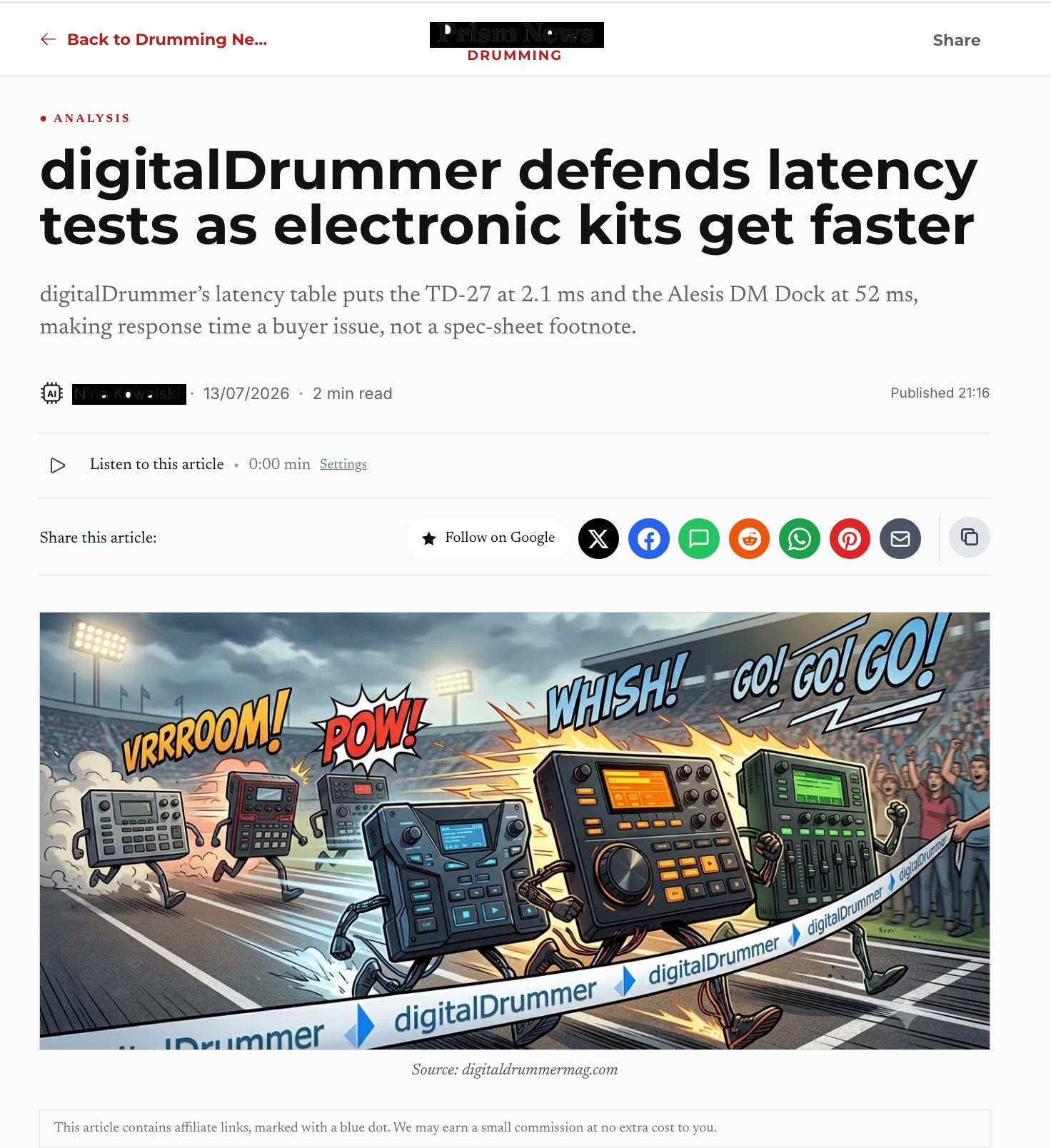
I recently received one of the strangest publicity requests of my career: a publisher invited me to share one of “my” latest articles with digitalDrummer readers.
The catch? I hadn’t written it.
An AI-powered news service had found one of our stories, rewritten it, repackaged it under its own masthead, added a byline and then asked me to help promote it to my audience.
I will not be promoting the article and have asked for it to be taken down.
Not because I object to AI. Anyone who follows my writing knows I’ve embraced it as a valuable tool. I use it for research, transcription, brainstorming and illustrations. Used responsibly, it can make journalists more productive and help us produce better work.
But this wasn’t AI assisting journalism. It was AI replacing it.
The rewritten article looked convincing enough. It quoted our latency figures, reproduced one of our graphics, cited digitalDrummer as the source and even drew on years of testing we’ve carried out.
Unfortunately, it also changed the story.
What had been an article explaining why latency measurements need context became a consumer buying guide. It introduced conclusions we hadn’t reached, shifted the editorial emphasis and relied on an outdated version of our latency results, giving readers an inaccurate impression of today’s fastest drum modules.
None of the changes were dramatic on their own. Together, they fundamentally altered the message.
And while I know that very few digitalDrummer readers will notice, I am more concerned about the impact on lay readers who know nothing about our work.
Over the past 16 years, digitalDrummer has tested hundreds of products, interviewed engineers, designers and artists, challenged manufacturers’ claims and developed methodologies that allow readers to compare products on a consistent basis.
Our latency figures didn’t appear because AI searched the web. They exist because someone spent years asking questions, designing tests, checking results and refining the process.
The expertise wasn’t scraped from the Internet. It created the information that later appeared on the Internet.
That distinction matters.
It also raises a much bigger question.
Today, AI-powered publishing platforms can produce articles on electronic drums, photography, cycling, gardening, astronomy, model railways, coffee, home automation, fishing, travel or almost any other specialist subject. The list is virtually endless.
But can a publisher that claims expertise across every conceivable hobby, profession and niche genuinely be an authority on any of them?
Specialist journalism has never been about collecting facts. It’s about understanding which facts matter. It’s knowing why one testing method produces a meaningful result, while another doesn’t. It’s recognising when a specification sheet hides more than it reveals.
Specialist journalism is about building relationships with the people designing products rather than simply reporting their press releases.
Most importantly, it’s earning readers’ trust over years of getting the details right.
That’s not something an algorithm can scrape, no matter how slickly information is presented online.
Credibility isn’t determined by how confidently information is shared. It’s measured by who did the work before the first word was ever written.
AI can write an article, but it can’t conduct an interview. It can’t spend weeks living with a new drum module. It can’t discover something that isn’t already on the web.
It can only inherit the work of people who did: people like digitalDrummer journalists.
As I’ve written before on the perils of plagiarism and “reporters” who rely on AI, original journalism still matters.
The "truth" is no more, AI, presidents, influencers, sigh..
You do right raising this issue!